
3D Wallpaper Designs That Add Depth and Dimension to a Room
A wall is physically flat, but it does not always have to look flat. The right 3D wallpaper can use perspective, light, shadow and scale to create the impression that the room continues beyond the surface of the wall.
A tunnel may appear to extend into the distance. An arch can seem to open onto another space. A forest path can draw the eye between rows of trees, while a panoramic landscape can make a solid wall feel more open. These effects are created by the image itself rather than by a physically raised surface.
This distinction is important. Printed 3D wallpaper is not the same as a textured wall panel. Its depth comes from visual composition. When the image is chosen carefully and placed on the right wall, the effect can be surprisingly convincing.
For this reason, 3D wall murals are often used not only as decoration but also as a way to change how the proportions of a room are perceived.
How Does 3D Wallpaper Create the Illusion of Depth?
Our eyes judge distance using several visual clues. Artists, photographers and designers can reproduce those clues inside a two-dimensional image.
Some of the most effective 3D wallpaper designs use a combination of:
- Perspective lines that become narrower in the distance.
- Objects that gradually become smaller.
- Foreground, middle-ground and background layers.
- Changes in light and shadow.
- Atmospheric haze in distant areas.
- Repeated objects such as columns, trees or arches.
- Paths, roads and corridors leading toward a vanishing point.
- Windows, doors and openings that appear to reveal another space.
None of these techniques physically changes the wall. Instead, they encourage the eye to interpret the printed image as having distance.
This is why some murals appear much deeper than others even though both are printed on the same type of wallpaper.
What Is the Difference Between 3D Wallpaper and Textured Wallpaper?
The term "3D wallpaper" is sometimes used for several very different products, so it helps to understand what you are looking at.
A printed 3D wall mural creates an optical depth effect. The wallpaper itself remains a wall covering, while the image creates the illusion of additional space.
Textured wall coverings and decorative panels, on the other hand, may contain physically raised surfaces that can actually be felt by hand.
At 3DWallpaperDecor, the emphasis is on photographic and artistic wall murals that create visual depth through the design. You can browse the dedicated 3D photo wallpaper collection to see how very different subjects can use the same principle in different ways.
Which 3D Wallpaper Designs Create the Strongest Sense of Depth?
Not every design described as 3D will create the same result. Images with a clear visual direction usually create a stronger illusion than images where every element appears at approximately the same distance.
1. Tunnel and Corridor Wallpaper
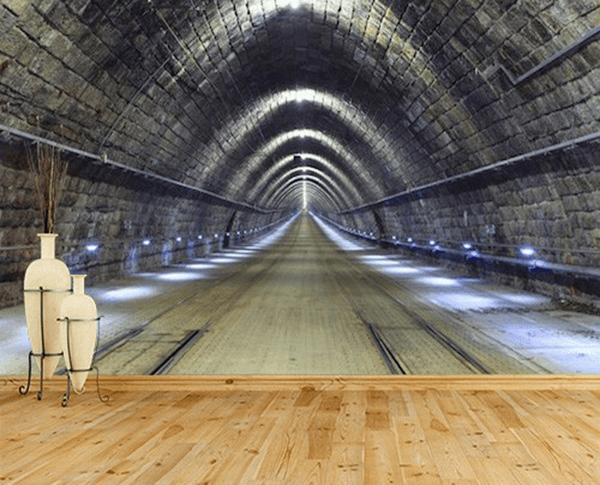
Tunnels are among the clearest examples of perspective in wall design.
The sides, ceiling and floor of a tunnel appear to become narrower as they move toward a distant point. Because the eye already recognizes this effect from real architecture, the brain interprets the printed lines as depth.
Long corridors, underground passages, futuristic tunnels and illuminated walkways can create a particularly dramatic feature wall.
These designs are often best used where the entire image can be seen without too much furniture covering the central perspective.
2. Arches, Windows and Openings
An architectural opening can make a solid wall appear to contain another space.
Imagine an arch overlooking the sea, a window opening onto mountains or a doorway leading toward a garden. The physical wall remains exactly where it is, but the visual boundary of the room becomes less obvious.
These designs can work particularly well in rooms where there is a large uninterrupted wall but few architectural details.
The illusion tends to be strongest when the proportions of the printed arch or window feel believable in relation to the room.
3. Forest Paths and Woodland Scenes
Nature can create depth without looking artificial.
A forest scene may contain trees in the foreground, smaller trees behind them and a path disappearing into the distance. Mist between the different layers can increase the impression that the landscape continues far beyond the wall.
This makes nature murals a good alternative for people who like the sense of depth created by 3D wallpaper but do not want a futuristic or geometric design.
Our wider wallpaper for home collection includes nature and landscape designs alongside 3D, city, window-view and other mural themes, making it easier to compare different approaches to creating visual space.
4. Roads, Streets and City Perspectives
A road leading toward a distant horizon is another classic way to create depth.
The same principle works with narrow streets, bridges, railway lines and urban architecture. Buildings become smaller as they move into the distance and parallel lines appear to converge.
City scenes can therefore combine two functions: they introduce an urban style while also making the wall feel less flat.
They are particularly effective in modern living rooms, offices, studios and commercial interiors.
5. Staircases and Architectural Geometry
Staircases naturally suggest movement between different levels. When combined with strong shadows or repeated architectural forms, they can produce an almost impossible sense of space.
Some designs are realistic, while others use surreal geometry that could never exist in a real building.
This type of 3D wallpaper works especially well when the aim is to make the wall itself the main feature of the room.
6. Abstract 3D Wallpaper
Not every depth effect needs to represent a real place.
Geometric shapes, layered curves, floating forms and digital compositions can create depth through overlapping elements, shadows and changing scale.
This can suit a contemporary interior better than a photographic landscape.
If you prefer a more artistic approach, our abstract art wallpaper murals include designs that use shape, movement and layered composition without depending on a realistic scene.
Can 3D Wallpaper Make a Room Look Bigger?
It can make a room feel visually larger, although it obviously cannot increase the physical floor area.
This distinction matters.
The strongest room-expanding effect generally comes from murals that create a convincing view beyond the wall. A path disappearing into a forest, a distant mountain range or an architectural opening can encourage the eye to continue farther than the actual wall surface.
The effect depends on several factors:
- The design of the mural.
- The dimensions of the wall.
- The viewing distance.
- The amount of furniture covering the image.
- The colors used in the artwork.
- The lighting in the room.
A poorly chosen mural will not automatically make a small room look larger simply because it is labelled 3D.
Best 3D Wallpaper for a Small Room
Small rooms often benefit from designs with a clear horizon or visual opening rather than extremely complicated graphics.
Choose an Image with Distance
Look for landscapes, paths, windows, arches, roads or other images where the eye can move toward a distant point.
Consider Lighter Areas
Light does not automatically make every room look larger, but murals with an illuminated distance can create a stronger feeling of openness than very dark, enclosed designs.
A scene where the foreground is slightly darker and the background gradually becomes brighter can be especially effective.
Avoid Too Much Small Detail
A very busy design can make a compact room feel visually crowded. Clear shapes and a strong central perspective are often easier to understand at a shorter viewing distance.
Think About Furniture Placement
If most of the mural will disappear behind a wardrobe, bookcase or large sofa, much of the depth effect may be lost.
Choose the wall where the perspective can remain visible.
Best 3D Wallpaper for a Large Room
Large rooms allow more freedom because there is usually a greater viewing distance.
From several meters away, large architectural murals, panoramic landscapes and dramatic geometric designs can be appreciated as complete compositions.
A wide living room wall, hotel lobby, restaurant or office reception area can therefore support a stronger design than a narrow hallway or compact bedroom.
Large walls are also suitable for images where the depth effect is spread across the entire composition rather than concentrated around one vanishing point.
3D Wallpaper for Living Rooms
The living room is one of the most suitable places for a 3D feature wall because there is usually enough viewing distance to appreciate the image.
The wall behind the sofa is often a good location. Furniture provides a natural base for the composition while most of the mural remains visible above it.
The television wall can also work, but the image should be chosen carefully because the screen may cover the most important part of the perspective.
What Works Well in a Living Room?
Good options include:
- Large landscape views.
- Forest paths.
- Architectural arches.
- Modern tunnels.
- City streets with perspective.
- Geometric 3D forms.
- Window-view murals.
The best design depends on whether you want the wall to feel peaceful, dramatic, modern or artistic.
3D Wallpaper for Bedrooms
A bedroom usually benefits from a slightly calmer visual approach.
Extremely bright tunnels or high-contrast geometric illusions may be impressive, but they can dominate a room intended for rest.
For bedrooms, softer landscapes, arches, cloud scenes, botanical depth and atmospheric nature images are often easier to live with.
The wall behind the bed is a natural location because the mural can become a large headboard-like feature without reducing usable floor space.
3D Wallpaper for Offices and Workplaces
Depth-effect wallpaper is not limited to homes.
Office reception areas, meeting rooms, studios, cafés, restaurants and other commercial interiors often contain large blank walls where a mural can create a much stronger identity than a plain painted surface.
An office might use architecture, city imagery, abstract geometry or a wide landscape depending on the atmosphere the business wants to create.
You can explore our separate wallpaper for workplace collection for mural ideas intended for professional and commercial environments.
3D Wallpaper for Hallways and Narrow Spaces
A narrow hallway is one of the most interesting places to experiment with perspective.
Because the real space already has a strong direction, an image that visually continues that direction can reinforce the impression of length.
For example, a corridor-style mural placed at the end of a hallway can make the eye feel as though the passage continues.
However, extremely detailed side-wall murals may feel too close when viewed from a short distance. In very narrow spaces, the end wall is often the better location for a strong perspective effect.
How Perspective Changes the Appearance of a Wall
Perspective is one of the most important factors in successful 3D wall art.
Consider a straight road. Close to the viewer, it appears wide. Farther away, it appears narrower until both sides seem to meet at the horizon.
The road itself has not physically become narrower. This is simply how distance is represented to the eye.
A wall mural can use exactly the same principle.
Columns may become progressively smaller. Floor tiles may appear to shrink. Trees may overlap and fade into mist. Architectural lines may converge toward a central point.
These visual clues are what give a flat image its apparent depth.

Why Lighting Matters in a 3D Wall Mural
Light and shadow can make a flat object appear solid.
If one side of a printed column is bright and the other side is darker, the eye interprets the change as a three-dimensional form.
The same technique can make arches, cubes, tunnels and other architectural elements appear to project forward or recede into the wall.
When choosing a mural, it can also help to consider the real lighting in the room.
A design where the printed light appears to come from roughly the same direction as the room's natural daylight may feel particularly convincing, although an exact match is not necessary.
Can Nature Wallpaper Create a 3D Effect?
Absolutely. A mural does not need geometric shapes or futuristic architecture to create depth.
Some of the most natural depth effects come from landscapes.
Forests
Trees positioned at different distances create layers. A path running between them adds direction, while mist can separate the foreground from the background.
Mountains
Mountain ranges naturally form overlapping layers. Nearby mountains appear darker and more detailed, while distant peaks become softer and lighter.
Waterfalls
A waterfall scene often includes foreground rocks, falling water and a landscape behind them. These layers can create a strong sense of distance.
Coastlines and Sea Views
A visible horizon immediately introduces distance. Beaches, cliffs, islands and open water can therefore make a wall feel visually more open.
If you prefer this kind of effect over geometric illusion, the nature and landscape designs within our home wallpaper categories provide many alternatives to traditional 3D artwork.
Window-View Wallpaper: Creating a View Where There Is No Window
One of the most direct forms of depth-effect wallpaper is the false window or architectural opening.
The image creates the impression that you are looking through the wall at something beyond it.
This could be:
- A tropical beach.
- A mountain valley.
- A forest.
- A city skyline.
- A Mediterranean landscape.
- A garden.
- A dramatic sky.
This type of design can be useful on walls without real windows or in interiors where the existing view is limited.
The effect is decorative rather than architectural, but a well-proportioned image can change the character of an otherwise plain wall.
City Wallpaper and Architectural Depth
Architecture is naturally full of perspective.
Long streets, rows of buildings, bridges, arcades and skylines create lines that lead the eye into the image. This is why city wallpaper can be particularly effective when the goal is to add depth without using an obviously surreal 3D design.
A black and white city scene can create depth while keeping the color palette controlled. A night city mural may create a more dramatic atmosphere, while a bright European street can make the wall feel more open and decorative.
City imagery can work well in living rooms, home offices and commercial spaces where a stronger urban character is appropriate.
Can World Map Wallpaper Create Depth?
Most world map wallpaper is not designed primarily as an optical illusion, but maps can still create visual dimension through texture, shading, relief effects and layered artwork.
Some designs use aged surfaces, stone textures or three-dimensional geographic forms that make the map appear to sit within or above the wall.
Maps are especially useful when you want a large statement wall but prefer an informative or graphic subject rather than a tunnel or landscape.
You can compare different styles in our world map wallpaper and map mural collection.
3D Wallpaper vs. a Dark Feature Wall
Both can create drama, but they affect the perception of space differently.
A very dark painted wall can visually bring a surface forward or create a more enclosed atmosphere depending on the room and lighting.
A perspective mural can do the opposite by suggesting that the surface continues backward.
This does not mean every small room needs a bright 3D mural or that dark walls should be avoided. Interior design is more complex than one simple rule.
The important point is to decide what you want the wall to do before choosing the decoration.
Which Wall Is Best for a 3D Wallpaper Mural?
The best wall is normally the one from which the complete perspective can be seen.
Consider:
- Where you normally enter the room.
- Where you sit most often.
- How far you will be from the wall.
- Whether furniture will cover the image.
- Whether doors or windows interrupt the wall.
- Where the mural's main vanishing point will appear.
A Large Uninterrupted Wall
This is usually the easiest surface because the design can be seen as intended.
The Wall Behind a Sofa
This works particularly well with panoramic landscapes, abstract compositions and wide architectural murals.
The TV Wall
This can work with texture, geometry and landscapes, but make sure the television does not hide the most important area of the image.
The End of a Hallway
This is an excellent location for corridors, arches, doorways and other strong perspective designs.
How to Choose the Right 3D Wallpaper for Your Interior
| If You Want... | Consider... | Be Careful With... |
|---|---|---|
| A room that feels more open | Landscapes, windows, arches and distant views | Very dark enclosed scenes |
| A dramatic focal point | Tunnels, geometric 3D designs and architecture | Adding too many other strong decorations |
| A natural atmosphere | Forests, waterfalls, mountains and coastal scenery | Images that clash with existing furniture colors |
| A modern interior | Abstract geometry, city architecture and digital forms | Overly complicated small-scale patterns |
| A calm bedroom | Soft landscapes, arches and atmospheric nature scenes | Very aggressive optical illusions |
| An interesting office | Architecture, city views, abstract designs and panoramas | Images that distract from the purpose of the workspace |
Color Can Strengthen or Reduce the Depth Effect
Perspective is important, but color also influences how we read an image.
Distant elements in real landscapes often appear lighter, less saturated and slightly hazier than nearby objects. Designers can reproduce this effect in a wall mural.
A forest scene, for example, may contain dark detailed trees in front and pale misty trees in the distance. This separation makes the image feel deeper.
Strong contrast can also add dimension, particularly in geometric artwork, although too much contrast can make a large wall feel visually aggressive.
Do You Need to Cover the Entire Wall?
For a strong 3D effect, full-wall coverage is usually the most convincing option.
If a perspective scene stops abruptly in the middle of a wall, the eye immediately sees the boundary of the print. Extending the mural across the complete wall helps the image feel more immersive.
There are exceptions. A smaller mural can work inside an architectural frame, recess or intentionally defined panel.
But if your goal is to make a wall appear to open into another space, covering the full available surface generally creates the stronger result.
Made-to-Measure 3D Wallpaper
The proportions of a 3D image matter. A design intended for a wide panoramic wall may not work in exactly the same way on a narrow vertical wall.
This is why wall dimensions should be considered together with the image rather than as an afterthought.
At 3DWallpaperDecor, murals can be produced according to the width and height entered for the wall. The image is therefore prepared around the dimensions of the project rather than being limited to a single fixed poster size.
Measure the Complete Wall
Measure the width and height of the surface you intend to cover. For irregular walls, doors, windows or other unusual architectural features, think about where those elements will fall within the image.
You can find more information about measuring and ordering in our custom wallpaper ordering guide.
Can You Create a 3D Wall Mural from Your Own Image?
Yes, provided that you have an image with sufficient quality for large-format printing.
Your photograph does not need to be a computer-generated 3D image. A landscape, street, architectural photograph or forest scene can already contain enough perspective to create strong visual depth.
For example, a photograph taken down a long street or along a forest path naturally contains a vanishing point.
If you have a suitable photograph or artwork, you can use the create your own photo wallpaper option to turn it into a custom-sized wall mural.
Common Mistakes When Choosing 3D Wallpaper
Assuming Every 3D Design Makes a Room Look Bigger
Some 3D designs create dramatic forms that appear to project out of the wall rather than recede into it. These can be impressive, but they do not necessarily create a feeling of extra space.
If visual enlargement is your main goal, choose an image with distance and perspective.
Ignoring Viewing Distance
A large optical illusion designed to be seen from several meters away may not work as well in a tiny room where you stand very close to the wall.
Covering the Vanishing Point with Furniture
If the feature that creates the depth disappears behind a cabinet or television, the illusion can lose much of its strength.
Choosing an Image That Is Too Busy
Complexity is not the same as depth. A simple path leading toward the horizon may create a stronger spatial effect than hundreds of decorative objects.
Forgetting the Rest of the Room
The mural may be the feature wall, but it still has to work with the sofa, floor, curtains, lighting and other colors in the interior.
Using Too Many Optical Effects at Once
A strong mural usually needs some visual breathing room. Combining a dramatic 3D wall with heavily patterned furniture, multiple bright colors and many decorative objects can reduce the impact of the wallpaper itself.
Frequently Asked Questions About 3D Wallpaper
Does 3D wallpaper actually have depth?
Printed 3D wallpaper creates the visual impression of depth through perspective, shading, scale and image composition. The printed mural itself is not a three-dimensional architectural structure.
Can 3D wallpaper make a room look larger?
A carefully chosen perspective mural can make a wall feel visually deeper and can therefore create a greater sense of space. Landscapes, paths, windows, arches and tunnels are particularly useful for this effect.
What type of 3D wallpaper is best for a small room?
Look for relatively clear compositions with distant views, open landscapes, paths or architectural openings. Extremely busy designs may make a small space feel more crowded.
Which wall should I use for 3D wallpaper?
A large uninterrupted wall with a clear viewing angle usually works best. Walls behind sofas, hallway end walls and feature walls are common choices.
Is 3D wallpaper suitable for a living room?
Yes. Living rooms usually provide enough wall area and viewing distance for a large 3D mural. Choose a design that coordinates with the furniture and overall interior style.
Can I use 3D wallpaper in an office?
Yes. Architectural, city, landscape and abstract murals can create strong feature walls in reception areas, meeting rooms and other professional interiors.
Are nature murals considered 3D wallpaper?
They can create a 3D-like depth effect when the image includes clear foreground, middle-ground and background layers. Forest paths, mountains and landscapes are good examples.
Can I order 3D wallpaper to fit my exact wall size?
Yes. Made-to-measure wall murals can be prepared according to the width and height of the wall, allowing the design to suit the proportions of the space.
Choose Depth That Suits the Room
The most successful 3D wallpaper is not necessarily the design with the most dramatic optical illusion.
A small bedroom may benefit from a soft landscape that quietly extends the visual space. A modern living room may suit a strong architectural opening. A hallway might work beautifully with a tunnel or long corridor, while an office may need a more restrained city or abstract design.
Start by deciding what you want to change about the room. If it feels enclosed, look for distance and open views. If the wall feels plain, consider architecture or geometric depth. If you want a calmer atmosphere, forests, mountains and other natural landscapes can provide both decoration and perspective.
Then consider the wall itself, the furniture in front of it and the distance from which the mural will normally be viewed.
When these elements work together, a flat wall can become much more than a background. With the right image, it can appear to open onto another landscape, continue into another room or extend far beyond its real dimensions.