
Wallpaper with Paste vs Peel and Stick: Which Is Better?
If you are planning a feature wall or a full-size wallpaper mural, one of the first decisions is how the wallpaper will be attached. Should you choose traditional wallpaper applied with paste, or is peel and stick wallpaper the easier option?
Peel and stick sounds simple. Remove the backing, press the wallpaper onto the wall and smooth it down. For small projects and perfectly smooth surfaces, that convenience can be useful. But when the project becomes larger, particularly when several wallpaper panels need to join together to create one continuous image, installation becomes more demanding.
Traditional wallpaper paste offers one major advantage that is easy to underestimate: working time. While the paste is still wet, the wallpaper can usually be adjusted on the wall. A panel that is slightly too far to the left or right can be moved, seams can be aligned more accurately and small positioning errors can be corrected before the adhesive sets.
This makes pasted wallpaper particularly practical for large custom wall murals, where every line, flower, building or landscape feature needs to continue correctly from one panel to the next.
In this guide, we compare wallpaper with paste and peel and stick wallpaper in detail, including installation, bubbles, wall preparation, repositioning, removal and suitability for large wall murals.
Paste Wallpaper vs Peel and Stick: What Is the Main Difference?
The basic difference is the adhesive system.
Traditional wallpaper uses a separate wallpaper adhesive or paste. Depending on the wallpaper material, the paste may be applied to the wall or to the back of the wallpaper. The panel is then positioned, aligned and smoothed into place.
Peel and stick wallpaper, also called self adhesive wallpaper or removable wallpaper, already has adhesive on the back. A release liner protects this adhesive until installation. The liner is gradually peeled away while the wallpaper is pressed onto the wall.
Both systems can produce an attractive result. The real difference becomes clearer when you look at the size of the project, the condition of the wall and how much control you want during installation.
| Feature | Wallpaper with Paste | Peel and Stick Wallpaper |
|---|---|---|
| Adhesive | Applied separately during installation | Already applied to the back |
| Repositioning | Easy to adjust while the paste is workable | Depends on the adhesive and how firmly it has been pressed down |
| Large wall murals | Very well suited | Possible, but requires careful handling |
| Aligning several panels | More forgiving because panels can be moved slightly | Accurate initial positioning is more important |
| Air bubbles | Can be smoothed out during wet installation | Must be pushed out carefully while applying the material |
| Wall condition | Requires a suitable, properly prepared wall | A clean, smooth surface is especially important |
| Small DIY projects | Easy | Very convenient |
| Extra adhesive required | Yes | No |
Why Wallpaper Paste Works So Well for Large Wall Murals
The larger the mural, the more important accurate positioning becomes.
A small decorative panel may be fairly forgiving. A full wall mural that is three, four or five metres wide is different. It is normally divided into several panels, and those panels have to come together to create one continuous picture.
If the first panel is slightly crooked, the error can become more noticeable with every additional panel.
This is where paste-applied wallpaper has a practical advantage.
Because the wallpaper is not instantly locked into one position, you usually have time to make small adjustments while the paste remains workable. A panel can be shifted slightly until the edge, seam and printed image line up correctly.
You do not have to get everything perfect at the first touch
This is one of the most useful differences between the two methods.
Imagine installing a large landscape mural. The first panel is straight at the ceiling, but at the bottom it needs to move a few millimetres. With a pasted wallpaper panel, you can normally make that adjustment before the adhesive dries.
The same applies when matching the next panel. Tree branches, buildings, horizon lines and other visual details can be checked carefully before the panel is finally smoothed into place.
For people who do not install wallpaper every day, this extra margin for correction can make the process considerably less stressful.
Is Peel and Stick Wallpaper Really Easier to Install?
Sometimes it is. But not always.
For a small area with a perfectly smooth surface, peel and stick wallpaper can be very convenient. There is no paste to prepare and no wet adhesive to apply.
On a large wall, however, the job becomes more complicated.
You need to keep the panel straight, gradually remove the backing, prevent the exposed adhesive from sticking in the wrong place and smooth the wallpaper at the same time.
With a tall panel, several things are happening at once.
The first position matters
The top of a peel and stick panel needs to be carefully aligned before the rest of the backing is removed.
If the panel begins slightly off vertical, the difference can become much larger by the time you reach the floor.
Some modern self adhesive wallpapers are repositionable and can be lifted away from the wall to correct the alignment. That is certainly helpful. Even so, correcting a large adhesive panel may require partially peeling it away and applying it again.
A pasted panel can usually be adjusted directly on the wet adhesive layer without completely removing it from the wall.
Paste Wallpaper vs Peel and Stick
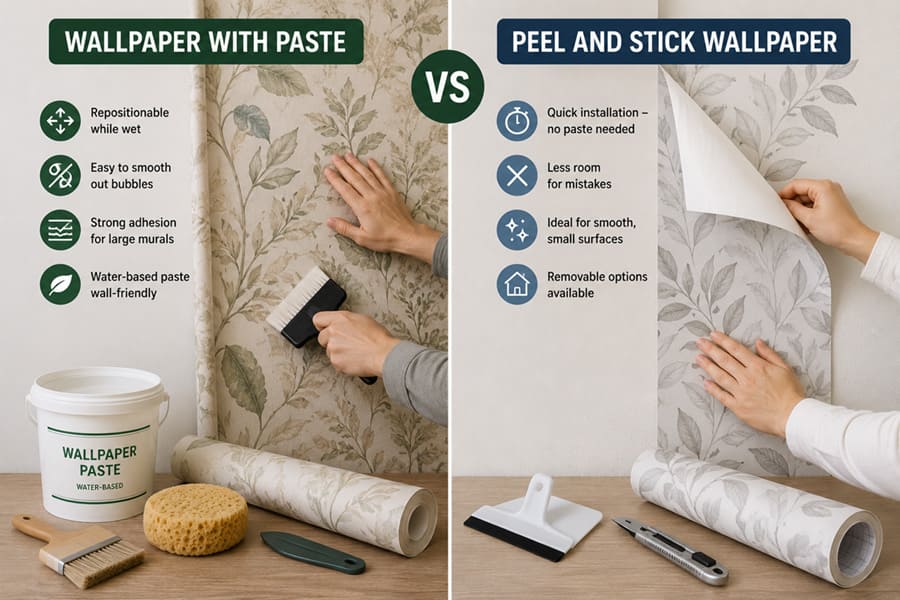
Which Wallpaper Is Better for Avoiding Air Bubbles?
Air bubbles are one of the most common concerns when installing wallpaper.
Neither type of wallpaper is magically immune to bubbles. Good wall preparation and correct installation matter with both systems.
The difference is how much flexibility you have while removing trapped air.
Wallpaper installed with paste
During wet installation, the panel remains workable for a period of time. As it is smoothed onto the wall, small pockets of air can be worked towards the outside edges with a suitable wallpaper smoother or brush.
If necessary, the panel can also be adjusted before being smoothed again.
When properly installed, this makes it relatively easy to create a flat, clean surface.
That does not mean pasted wallpaper can never develop bubbles. Poor wall preparation, insufficient adhesive or incorrect installation can still cause problems. But the wet installation method gives you useful time to deal with them before the wallpaper sets.
Peel and stick wallpaper
Peel and stick wallpaper can also be installed without bubbles, but the backing should normally be removed gradually rather than all at once.
As the adhesive surface touches the wall, the wallpaper needs to be smoothed carefully from the centre towards the edges.
If too much adhesive surface is allowed to contact the wall at once, air may become trapped behind the material. That is why manufacturers often recommend working in small sections and using a smoothing tool throughout the installation.
Wall Preparation Matters for Both Systems
No wallpaper should be installed over a loose, dusty or badly damaged surface.
The best starting point for a wall mural is usually a wall that is:
- clean
- dry
- firm
- smooth
- free from loose paint
- free from dust and grease
- properly prepared for wallpaper
Wall preparation is especially important with self adhesive wallpaper because the pre-applied adhesive needs consistent contact with the wall surface.
Why textured walls can be difficult for peel and stick wallpaper
On a heavily textured wall, only the raised areas may make full contact with the adhesive. This reduces the total bonding area.
The wall texture may also remain visible through thinner wallpaper materials.
For that reason, a smooth wall is normally the safest choice for any high-quality wall mural and particularly important for peel and stick materials.
What About Newly Painted Walls?
Fresh paint should be allowed to cure fully before wallpaper is installed.
This is particularly important with peel and stick products because their performance depends directly on the relationship between the pressure-sensitive adhesive and the painted surface.
Different paint finishes can behave differently, so the wallpaper manufacturer's instructions should always be followed.
The same principle applies to pasted wallpaper. A stable, properly prepared surface provides a much better foundation than paint that is still curing or flaking away from the wall.
Does Water-Based Wallpaper Paste Damage the Wall?
Traditional wallpaper pastes are commonly mixed with water and are designed specifically for wallpaper installation.
On a correctly prepared wall, a suitable water-based wallpaper paste is a wall-friendly and well-established method of installation. It does not behave like a permanently tacky pressure-sensitive adhesive.
However, it is important to be realistic. No responsible wallpaper supplier should promise that removing any wallpaper from any wall can never affect the surface underneath.
What happens during removal depends on several factors, including:
- the condition of the paint
- whether the wall was properly primed
- the type of plaster or drywall
- the wallpaper material
- the adhesive used
- how the wall was originally prepared
Good wall preparation is therefore just as important when thinking about future removal as it is during installation.
Why Paste Is Useful for Made-to-Measure Wall Murals
A custom wall mural is different from a small decorative sticker.
The image is created to cover a specific wall area, and several panels may need to form one continuous scene. This makes accurate alignment particularly important.
A difference of only a few millimetres may be difficult to notice on plain wallpaper. On a photographic mural, however, the same difference may interrupt a face, building, line or landscape.
For this reason, the ability to make small corrections while installing the panels is particularly valuable.
At 3DWallpaperDecor's wallpaper for home collection, wall murals can be selected for different room styles and produced according to the dimensions entered for the wall.
Advantages of Wallpaper Installed with Paste
1. More time to align the wallpaper
The panel remains adjustable while the paste is workable. This makes accurate positioning easier, especially when several panels must line up.
2. Small mistakes can be corrected
If a panel is a few millimetres out of position, it can normally be moved carefully before the adhesive sets.
3. Very suitable for large walls
A full wall mural requires accurate seams and consistent alignment. Wet installation provides extra control throughout the process.
4. Air can be smoothed out during installation
Because the panel remains movable, trapped air can be pushed towards the edges while the wallpaper is being installed.
5. It works particularly well for detailed murals
Architectural lines, landscapes, geometric patterns and other continuous designs need accurate seams.
This is especially useful with 3D wallpaper murals, where perspective lines and visual depth often continue across several panels.
6. The adhesive is applied when you are ready to install
The wallpaper does not depend on a pre-applied pressure-sensitive adhesive layer. The adhesive system is prepared as part of the installation process.
Possible Disadvantages of Wallpaper Paste
A fair comparison also needs to acknowledge the disadvantages.
- The paste needs to be prepared and applied.
- The floor or nearby furniture should be protected while working.
- Paste can drip if it is applied carelessly.
- The wallpaper needs time to dry.
- Tools need to be cleaned afterwards.
These are additional steps, but they do not necessarily make the wallpaper itself harder to install.
In fact, the wet adhesive layer is one of the reasons large panels can be easier to position accurately.
Advantages of Peel and Stick Wallpaper
Peel and stick wallpaper has several genuine advantages and can be the right product for certain projects.
1. No separate wallpaper paste
The adhesive is already on the product, so there is no paste to prepare or spread.
2. Less wet preparation
Because no liquid wallpaper adhesive is being applied, the process can feel cleaner, especially on small projects.
3. Convenient for small surfaces
A small, smooth feature area can often be covered quickly with peel and stick wallpaper.
4. Some products are designed to be removable
Certain peel and stick wallpapers are specifically designed for temporary interiors and can be useful in rental properties, dorm rooms or short-term design projects.
Removal performance varies by product and wall surface, so the manufacturer's recommendations should always be checked.
Possible Disadvantages of Peel and Stick Wallpaper
The wall needs to be very smooth
Dust, texture and surface irregularities can interfere with adhesion. A poorly prepared wall can lead to lifting edges or other installation problems.
Large panels can be harder to handle
With a large panel, the installer needs to control the backing paper, alignment and smoothing at the same time.
Having a second person can make this considerably easier.
Air needs to be removed as the wallpaper is applied
The wallpaper should be installed gradually and smoothed continuously. Allowing a large adhesive area to contact the wall too quickly can trap air underneath.
Repositioning depends on the product
Some modern peel and stick wallpapers are designed to be repositionable. Others become more difficult to move after being firmly pressed onto the wall.
There is therefore no single answer that applies to every self adhesive wallpaper.
Which Is Easier for Beginners?
The answer depends heavily on the size of the project.
For a small piece of wallpaper on a smooth surface, peel and stick can be very straightforward.
A full-size wall mural is different.
Once several large panels need to join together, accurate alignment becomes more important than simply avoiding the use of paste.
For this kind of project, traditional paste can actually be more forgiving for a beginner because the position of each panel can be fine-tuned before the adhesive dries.
| Project | Often the Better Choice | Reason |
|---|---|---|
| Small decorative panel | Peel and stick | Fast application with no separate paste |
| Full living room wall | Wallpaper paste | More control over positioning |
| Multi-panel photo mural | Wallpaper paste | Easier seam and image alignment |
| Temporary small decoration | Peel and stick | Removable products can be convenient |
| Detailed 3D mural | Wallpaper paste | Perspective lines can be aligned carefully |
| Perfectly smooth furniture panel | Peel and stick | The smooth surface suits pressure-sensitive adhesive |
Installing a Wall Mural with Wallpaper Paste
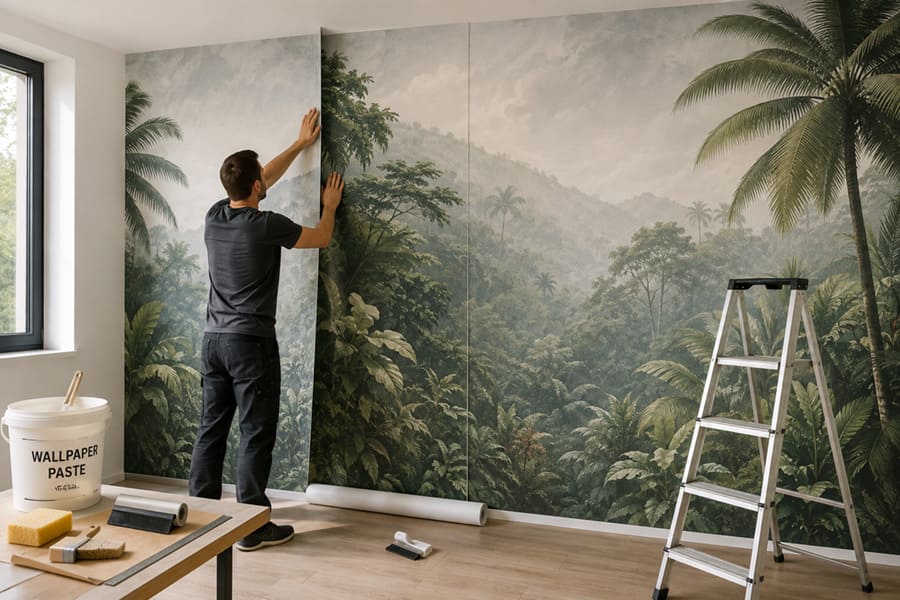
How to Install a Wall Mural with Paste
A successful installation starts before the first panel touches the wall.
1. Prepare the wall
The wall should be clean, dry, firm and as smooth as possible. Remove old wallpaper residue, loose paint and dust. Repair obvious dents or cracks before beginning.
2. Check your wall dimensions
Measure the wall again before installation and make sure all mural panels are present.
Lay the panels out in the correct order before applying any adhesive. This makes it much easier to understand how the image fits together.
3. Mark a perfectly vertical starting line
Do not assume that the corner of a room is perfectly straight.
Use a spirit level or laser level to mark a vertical guide for the first panel. This is one of the most important steps of the entire installation.
4. Prepare and apply the wallpaper adhesive
Follow the instructions supplied with the adhesive. Apply it evenly and avoid unnecessarily thick or uneven areas.
5. Position the first panel
Place the first panel along the vertical guide and check the position carefully.
If it is not quite right, the wet adhesive normally gives you time to move it slightly before smoothing it fully onto the wall.
6. Smooth from the centre towards the edges
Use an appropriate wallpaper tool and work methodically. This helps remove trapped air and creates even contact with the wall.
7. Align the next panel with the image
With a mural, you are not simply joining two pieces of wallpaper. You are rebuilding one large image across the wall.
If you are installing a floral wallpaper mural, for example, stems, leaves and flowers may continue directly across the seam.
Take a moment to check these details before the panel is fully smoothed down.
8. Check every seam before moving on
Small alignment corrections are much easier to make while the adhesive is still workable than after the wall has dried.
Why the First Wallpaper Panel Matters So Much
Every panel after the first one follows the position of that starting panel.
If the first panel is slightly crooked, each following panel may move further away from the correct position.
This is why using a level or laser is worth the extra few minutes.
The same rule applies to both pasted and peel and stick wallpaper, but the ability to make small adjustments is particularly useful when using traditional wallpaper paste.
Can You Install a Wall Mural by Yourself?
Yes, many wall murals can be installed by one person with careful preparation.
For particularly tall or wide panels, a second person can still make the process easier. One person can control the upper section while the other checks the alignment and smooths the wallpaper.
With peel and stick wallpaper, a helper can be even more useful because somebody also needs to control the release liner while keeping the adhesive surface away from the wall until the panel is correctly positioned.
Which Method Is Better for 3D Wallpaper?
3D wall murals often contain architecture, perspective lines, tunnels, geometric forms and other features that continue across panel seams.
If one panel is slightly out of position, a straight architectural line may suddenly break at the seam and reduce the visual effect.
This is one reason why the ability to adjust a pasted panel can be particularly valuable for 3D wallpaper.
You can explore different perspective and depth-effect designs in our 3D wallpaper mural collection.
Which Method Is Better for Floral Wall Murals?
Large floral designs often continue across several panels. A flower, leaf or branch may begin on one strip and continue directly onto the next.
A small alignment error can therefore become very visible.
The ability to move the wallpaper slightly during wet installation makes it easier to line these design elements up accurately.
What About Custom Wallpaper Made from Your Own Photo?
Alignment becomes even more important when the mural contains a personal photograph.
Faces, buildings and other recognisable objects can make even a small mismatch between panels noticeable.
If you want to turn a personal image, photograph or graphic into a wall mural, you can use the create your own photo wallpaper option and produce a mural to suit the required wall dimensions.
What About Removing the Wallpaper Later?
This is an area where broad claims should be treated carefully.
Some peel and stick wallpapers are specifically designed to be removable. That makes them attractive for temporary decorating projects and rental properties.
Pasted wallpaper can also be removable, depending on the wallpaper material, wall preparation and adhesive system.
Whether the paint underneath remains perfect after removal depends on the quality and condition of the wall, not simply on whether the wallpaper was labelled peel and stick.
If future removal is particularly important, a test area and careful wall preparation are always sensible.
Is Peel and Stick Wallpaper Good for Textured Walls?
Heavy wall texture is generally not ideal for peel and stick wallpaper.
A pressure-sensitive adhesive works best when a large percentage of its surface can make direct contact with the wall.
Texture reduces that contact area and may also become visible through the wallpaper.
A smoother wall normally gives a cleaner result for both pasted and self adhesive wall murals.
What Is Better for a Rental Property?
Peel and stick wallpaper is often marketed specifically to renters because some products are designed for temporary installation and later removal.
For a small feature area, this may be a very practical solution.
For a large custom mural, however, you should still consider the condition of the wall, the type of paint and the complexity of installation.
Being removable does not automatically mean that a large self adhesive mural will be easier to install.
What Is Better for a Living Room Feature Wall?
A living room feature wall is exactly the kind of project where wallpaper paste has significant practical advantages.
The wall is often large, the mural is viewed from several metres away and any misaligned image features may be easy to notice.
With paste, each panel can be positioned carefully before it is allowed to dry.
For this reason, we generally prefer pasted wallpaper for a full living room mural rather than selecting an adhesive system simply because it appears quicker at first.
Wallpaper Paste vs Peel and Stick for Commercial Spaces
Large wall murals are also frequently used in offices, restaurants, hotels, salons and other commercial spaces.
In these locations, the finished appearance normally matters more than saving a few minutes during installation.
A large mural behind a reception desk or across a restaurant wall may contain many square metres of printed material. Accurate seams and predictable positioning become increasingly important as the project gets larger.
For these kinds of permanent installations, traditional wallpaper paste remains a very practical solution.
Does Paste Wallpaper Cost More to Install?
There is no universal answer because wallpaper prices vary by material, manufacturer and design.
Paste itself is generally only one small part of the overall cost of a large custom wall mural.
At 3DWallpaperDecor, wallpaper adhesive is supplied with wall mural orders, so it does not need to be purchased separately for the installation.
When comparing costs, it makes more sense to look at the entire project:
- wall mural size
- wallpaper material
- print quality
- custom sizing
- installation requirements
- whether professional installation is needed
Why We Prefer Paste for Large Photo Wallpaper Murals
Peel and stick wallpaper is useful and we would not describe it as a bad product category. For a small, smooth surface or temporary decoration, it can be an excellent choice.
A large photo wallpaper mural has different requirements.
Several panels need to become one image. The seams should be neat, the picture should continue correctly and the installer needs enough control to make small adjustments.
That is where traditional wallpaper paste offers a clear practical advantage.
The additional installation step is compensated for by greater flexibility once the wallpaper is on the wall. Panels can be fine-tuned, seams can be checked and air can be smoothed towards the edges before the adhesive dries.
For a permanent, made-to-measure wall mural, we consider that control more valuable than simply avoiding the use of paste.
Paste Wallpaper or Peel and Stick: Which Should You Choose?
| Situation | Wallpaper with Paste | Peel and Stick |
|---|---|---|
| Full living room feature wall | Excellent choice | Possible, but requires careful application |
| Large custom wall mural | Excellent choice | Possible depending on the product |
| Several image panels | More forgiving for alignment | Accurate positioning is essential |
| Small smooth decorative area | Works well | Very convenient |
| Temporary decoration | Depends on material and wall | Useful with removable products |
| Beginner installing a large mural | More forgiving during alignment | Requires careful control while sticking |
| Detailed 3D or photographic image | Very suitable | Precise alignment is especially important |
Common Wallpaper Installation Mistakes
1. Skipping wall preparation
Dust, damaged paint and uneven surfaces can cause problems with either installation method.
2. Using the corner of the room as a level
Room corners are not always perfectly vertical. Use a spirit level or laser to establish a straight starting line.
3. Removing all the backing from peel and stick wallpaper at once
This exposes a large adhesive surface and makes the panel much harder to control. Removing the backing gradually is usually safer.
4. Failing to smooth air towards the edges
Work methodically and push trapped air out rather than pressing randomly across the panel.
5. Looking only at the seam and not the image
With a wall mural, the printed design needs to match as well as the panel edges.
6. Working too quickly
A large wall mural is intended to remain on the wall for years. Spending a little more time aligning the panels is more important than finishing the installation as quickly as possible.
Frequently Asked Questions About Paste and Peel and Stick Wallpaper
Which is better, peel and stick wallpaper or traditional wallpaper?
For small smooth surfaces and temporary decoration, peel and stick wallpaper can be very convenient. For large wall murals and multi-panel photographic designs, traditional wallpaper paste often provides more control because the panels can be adjusted while the adhesive remains workable.
Is wallpaper with paste difficult to install?
Not necessarily. With a properly prepared wall and a straight starting line, a pasted wall mural can be installed by a careful DIY user. The ability to reposition a panel slightly can actually make large mural installation more forgiving.
Can pasted wallpaper be repositioned?
Usually yes, during the workable period of the wallpaper adhesive. The exact amount of working time depends on the adhesive and wallpaper material.
Does traditional wallpaper get air bubbles?
Any wallpaper can develop bubbles if installed incorrectly. During wet installation, however, the panel can be smoothed carefully from the centre towards the edges while the adhesive is still workable.
Is peel and stick wallpaper bubble free?
Not automatically. Self adhesive wallpaper needs to be applied gradually and smoothed as the backing is removed. Air can become trapped if a large section is pressed onto the wall too quickly.
Can peel and stick wallpaper be repositioned?
Some products are specifically designed to be repositionable. Others become harder to move after firm pressure has been applied. Always check the instructions for the specific product.
Which wallpaper is better for large walls?
For large photographic wall murals, we generally prefer wallpaper installed with paste because it gives the installer more control when aligning several panels.
Which is easier for beginners?
For a small project, peel and stick can be extremely convenient. For a large multi-panel mural, paste can be more forgiving because the first position does not necessarily have to be perfect immediately.
Does peel and stick wallpaper work on textured walls?
Heavily textured surfaces are generally not ideal. The adhesive needs sufficient contact with the wall and texture can also affect the appearance of the finished mural.
Is wallpaper paste included with 3DWallpaperDecor wall murals?
Yes. Wallpaper adhesive is supplied with 3DWallpaperDecor mural orders, together with installation guidance.
Can I order a wall mural in my exact wall size?
Yes. Wall murals can be ordered according to the dimensions required for the project. Measure the wall carefully before ordering and choose the width and height for the selected image.
Conclusion: For Large Wall Murals, Paste Gives You More Control
Peel and stick wallpaper deserves its popularity. It is convenient, clean and particularly useful for smaller projects, smooth surfaces and temporary decorating.
But convenience before installation is not the only thing that matters.
When a wallpaper mural covers an entire wall, the ability to make small corrections becomes extremely valuable. Several panels need to join together as one image, and every seam, line and visual detail needs to be positioned correctly.
Traditional wallpaper paste gives you time to do that.
While the adhesive is workable, the panel can be adjusted, the seam can be checked and trapped air can be smoothed towards the edges. For large photographic murals, detailed 3D designs and custom wall-size projects, this additional control often makes the installation process easier rather than harder.
So if you are choosing between peel and stick wallpaper and a pasted wall mural, do not ask only which option requires fewer steps. Consider the size of the project, the wall surface and how much precision the finished design requires.
For a permanent, large-scale wall mural, traditional wallpaper paste remains one of the most reliable and forgiving installation methods.
You can explore 3DWallpaperDecor to find made-to-measure photo wallpaper and 3D wall mural designs, or follow the wall mural ordering guide to see how size, image and material are selected.